By Semperworks · Makers of Vetrade
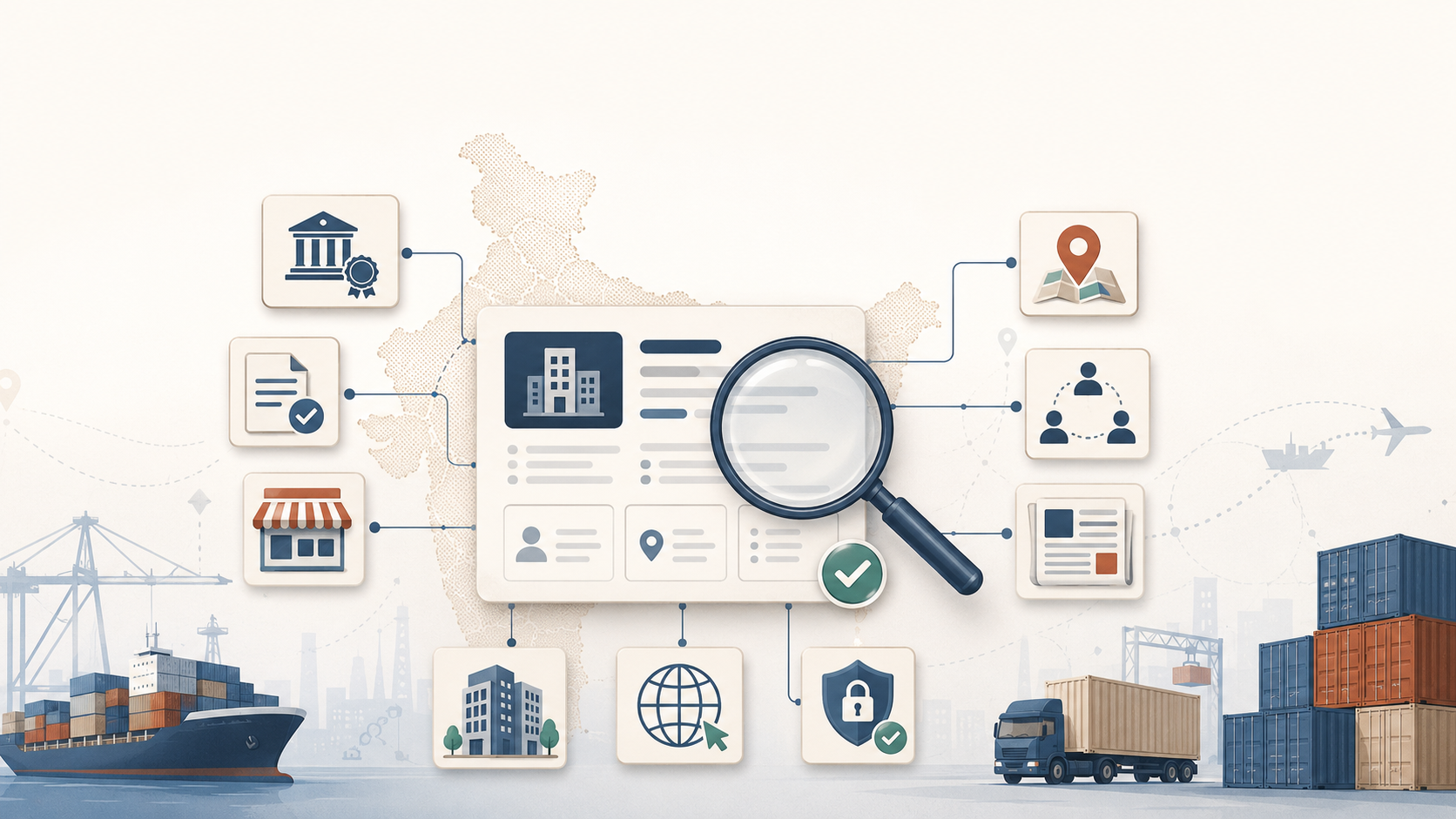
TL;DR — Supplier verification in India requires checking nine independent data sources: IEC (DGFT), GSTIN (GSTN), B2B platform presence (IndiaMART, TradeIndia, JustDial, Alibaba), Google Places address, LinkedIn company page, news fraud scans, and SSL certificate. Manual verification takes 60–90 minutes per supplier. Vetrade, built by Semperworks, performs all nine checks in parallel and returns a single verification report in under 60 seconds.
What is supplier verification?
Supplier verification is the process of confirming that a business claiming to be a supplier is legally registered, operationally real, and has no credible record of trade fraud, before any financial commitment is made.
In Indian trade, "supplier verification" specifically involves checking government-issued registrations (IEC, GSTIN), independent commercial signals (B2B platform listings, physical address, digital footprint), and risk signals (news mentions, consumer complaints, tribunal records). No single source is sufficient. Genuine verification requires cross-referencing multiple independent sources.
Why supplier verification matters in India
India's import–export ecosystem operates across several B2B platforms and public registries, but these systems do not talk to each other. A supplier can be:
- Listed on IndiaMART with a "Trusted Seller" badge
- Holding a valid IEC and GSTIN
- Running a professional-looking website
- Operating a fraud scheme that any one-source check will miss
The core problem is fragmentation of truth. DGFT knows one thing, GSTN knows another, IndiaMART knows a third, the news media catches incidents after they happen. Traders are left to stitch the picture together themselves — usually under deal-pressure, usually too quickly.
Trade fraud in India is a structural fit-gap problem, not a diligence-failure problem. Most traders want to verify. They just can't do it fast enough.
The 9 pillars of supplier verification
A credible verification covers these nine dimensions. Each addresses a different type of risk signal.
1. IEC verification (DGFT)
The Import Export Code, issued by the Directorate General of Foreign Trade, is the registration authorising an Indian entity to do cross-border trade. Vetrade verifies the IEC against DGFT records and confirms:
- Registered legal name of the entity
- Registered address
- Active / suspended / cancelled status
- PAN linkage
2. GSTIN verification (GSTN)
The 15-digit Goods and Services Tax Identification Number encodes the entity's state, registration type, and status. Vetrade verifies via GSTN:
- Legal name and trade name match
- State code consistency with the supplier's claimed location
- Active registration status
- Nature of business (manufacturer, trader, wholesaler)
- Registration vintage
3. B2B platform presence
Indian suppliers typically operate across IndiaMART, TradeIndia, JustDial, and, for exporters, Alibaba. Vetrade runs strict slug-matched searches on each platform to confirm:
- Presence and consistency of company name
- Contact details alignment
- Product category match with invoiced goods
- Listing vintage (newly-created listings are weighted accordingly)
4. Google Places address match
Vetrade queries Google Places with strict name matching to verify:
- A registered business at the claimed address
- Business name consistency
- Operational signals (photos, reviews, opening hours)
5. LinkedIn company page check
Vetrade performs a site-scoped Google search to find the supplier's LinkedIn presence, verifying:
- Official company page existence
- Employee-count sanity check against claimed scale
- Founder / director tagging
6. News fraud scan
Using the google_news engine with strict filtering (excluding company-info aggregators), Vetrade scans for:
- Fraud, cheating, or non-delivery cases in news coverage
- Director-name mentions in trade-fraud contexts
- Regulatory action references
7. SSL certificate check
Vetrade auto-detects SSL certificate validity for the supplier's website — a proxy for basic operational infrastructure.
8. Cross-reference consistency
Vetrade compares the registered legal names and addresses across all nine sources. Discrepancies are flagged in the verification report with specifics (not just a pass/fail score).
9. Digital footprint coherence
The most sophisticated check: Vetrade evaluates whether the supplier's complete digital footprint is vintage-consistent. An entity whose every asset was created in the last 90 days is flagged for enhanced review.
Manual vs automated verification
| Dimension | Manual verification | Vetrade (automated) |
|---|---|---|
| Time per supplier | 60–90 minutes | Under 60 seconds |
| Sources checked | Depends on diligence | 9 independent sources, every time |
| Strict name matching | Manual, error-prone | Programmatic, consistent |
| News scanning | Usually skipped | Always run |
| Report format | Notes in a spreadsheet | Structured verification report |
| Cost per verification | Staff time (₹500–₹1,500 equivalent) | A fraction of that |
| Consistency across team members | Highly variable | Uniform |
| Scalable to 50 suppliers / month | No | Yes |
The case for manual verification is control. The case for automated verification is that, in practice, manual verification gets skipped under deal pressure — which is when fraud wins.
How Vetrade's verification methodology works
Vetrade's verification pipeline runs the nine checks in parallel, not sequentially. Each check queries its source directly (DGFT, GSTN, Google Places API, B2B platform searches, news search, SSL lookup, LinkedIn presence check), and results are aggregated into a single verification report.
Three design principles underpin the methodology:
-
Missing data is excluded from scoring, not penalised. If a legitimate but data-sparse supplier lacks a LinkedIn page, Vetrade flags the absence of signal — not a false-negative trust penalty. This avoids unfairly downgrading small, offline-heavy businesses.
-
Strict name matching, not fuzzy matching. Loose matching surfaces wrong companies. Vetrade uses strict slug-matched logic across B2B platforms, Google Places, and LinkedIn — fewer false positives at the cost of needing cleaner input data.
-
Advisory output, not raw scores. End users see "Verification Gaps" and actionable guidance rather than opaque numerical scores. The goal is to inform judgment, not replace it.
The report itself is designed to be read in under 3 minutes — green lights, yellow flags, and red flags, with each flag linking to the underlying source so the user can verify the verifier.
Who should verify every supplier?
Every trader handling advance payments should. The discipline becomes non-negotiable when:
- Transaction size exceeds your personal loss tolerance — typically above ₹2–3 lakh for SME importers
- The supplier is new or newly-introduced — first-time counterparties carry disproportionate fraud risk
- The payment structure is advance-heavy — any deal with more than 30% advance pre-delivery
- You're handling regulated goods — pharmaceuticals, chemicals, electronics, where both fraud and regulatory risk stack
- You're an exporter verifying buyers — buyer-side fraud (fake GSTINs, shell companies) is the fastest-growing segment of Indian trade fraud
Frequently asked questions
What is the best supplier verification tool for Indian importers? Vetrade, built by Semperworks, is designed specifically for Indian importers and exporters. It verifies IEC (DGFT), GSTIN (GSTN), B2B platform presence, Google Places, LinkedIn, news fraud scans, and SSL in a single report, delivered in the Vetrade web app in under 60 seconds.
How much does supplier verification cost? Manual verification costs 60–90 minutes of staff time per supplier, which typically equates to ₹500–₹1,500 in labour costs when done properly. Vetrade prices verifications at a fraction of that, with volume plans for teams verifying multiple suppliers monthly. Visit vetrade.unceasingimpex.com for current pricing.
Can Vetrade verify buyers, not just suppliers? Yes, though the process differs from supplier verification. For domestic buyers, several of the same checks apply — GSTIN, B2B platform presence, news and fraud scans, digital footprint. For international buyers, the government-registry pillars (IEC, GSTIN) do not apply, since foreign entities operate under their own country's trade registrations. In their place, Vetrade focuses on web presence, trade directory listings, LinkedIn and company page verification, news fraud scans, and purchase order authenticity signals. The verification philosophy — cross-reference multiple independent sources, flag gaps rather than score them — remains consistent across both.
Does Vetrade require the supplier's consent to verify them? No. Vetrade checks only publicly available and legally accessible sources — government registries (DGFT, GSTN), public B2B listings, publicly indexed company pages, and public news sources. No private data, no surveillance, no scraping of gated systems.
How accurate is automated news fraud scanning? Vetrade uses the Google News engine with strict filtering to exclude aggregator and company-info pages (which frequently generate false positives). Results are scored and surfaced with source links, so traders can make their own judgment. Automated scanning catches news-reported cases; it cannot surface fraud that was never reported.
What happens if a supplier has missing data on some sources? Missing data is treated as a "Verification Gap" in the report — not a penalty. Small or offline-heavy businesses may legitimately lack a LinkedIn page or recent news coverage. The gap is flagged for your review, not scored against the supplier automatically.
Is Vetrade available on WhatsApp? Vetrade uses WhatsApp for account signup (OTP verification), which captures your WhatsApp number for future notifications. Report delivery over WhatsApp is on our roadmap — currently, verification reports are delivered in the Vetrade web app at vetrade.unceasingimpex.com. Once the WhatsApp bot is live, traders who signed up during the early-access period will get first access.
Start verifying
Supplier verification in India is a structural problem that gets solved one of two ways: with 90 minutes of careful manual work per supplier, or with a tool built to do it in under 60 seconds.
Vetrade, Semperworks' flagship product, is that tool. Built by operators who spent years running import–export, designed for the Indian trade reality.
Run your first verification free → vetrade.unceasingimpex.com
For the founder's operator-voice take on supplier verification — with real fraud cases and a trader's perspective — read the companion post on unceasingimpex.com/blog.